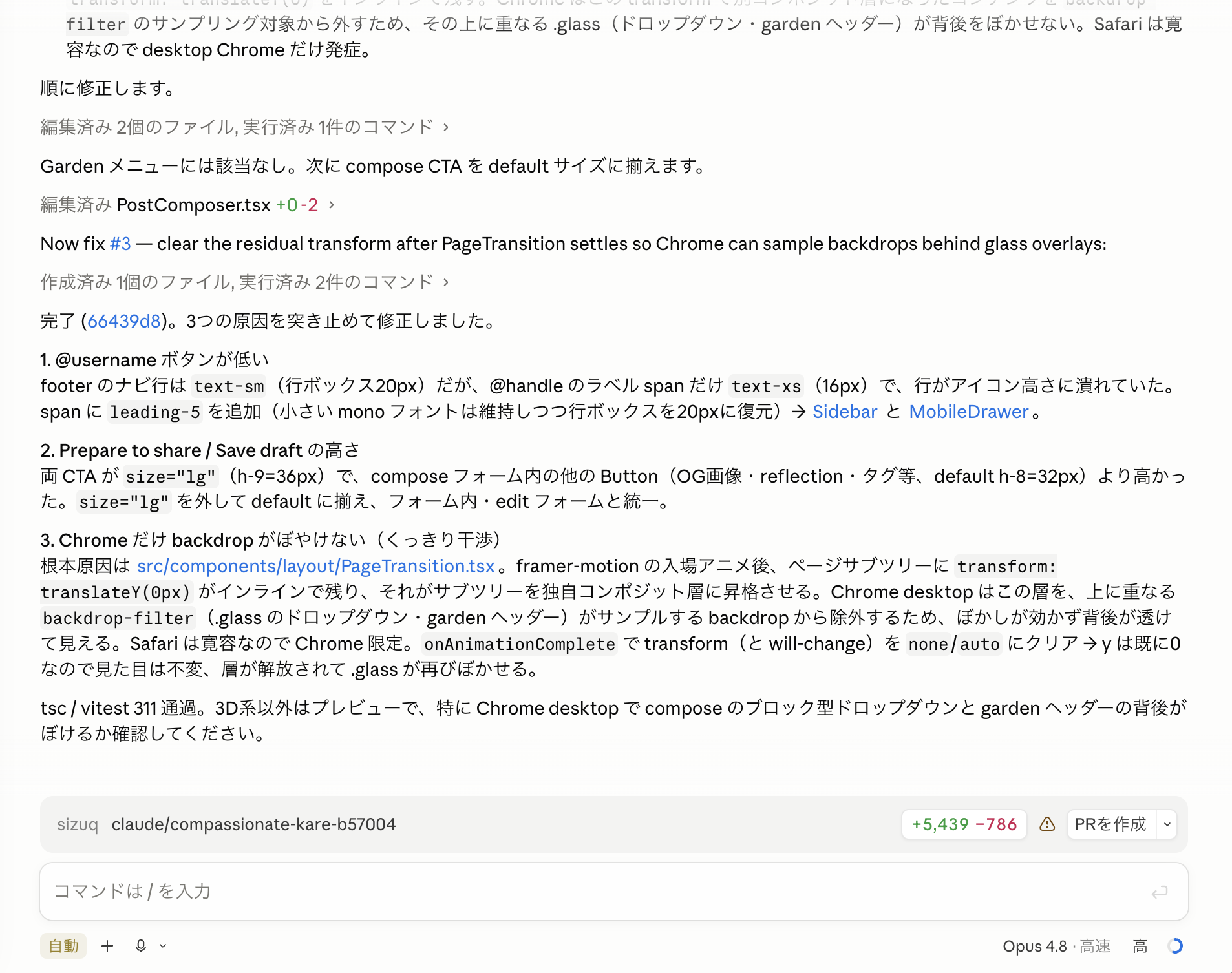
sizuq gardenをエクスポートして、Lolipopなど別のホスティング基盤に置ける機能をテスト中。Vercel以外の選択肢を増やして、公共性を高める効果がありそうです。FTPS/SFTPで自動同期できるようにする計画もあります。
AK
akira
@akiraAtmosphere
Burning◉
Thoughts
1 month ago
Original and Copy
“Be the first to do what no one else has done. That’s how you spark innovation.” You hear this slogan constantly, especially in tech and startup circles. And it’s true that if you move into territory where someone has already built their fortress, you’ll be defeated unless you bring some distinctive added value or originality. To break into an auto industry dominated by Toyota, GM, and Volkswagen and still claim a global position, you needed something like Tesla’s EV vision, its software-first design, and later its wild concepts and execution power in Autopilot and FSD.
And yet, even civilization-scale projects aren’t always producing something “original.” Over the past year I’ve been using Codex, Claude Code, and lately Grok Build on a daily basis, and I can’t help feeling that each company’s designs are steadily “converging.” I haven’t had much chance to try Gemini, Antigravity, Cursor, or the Chinese models, but I suspect they probably show the same tendency.
Take, for example, the button that lets you reset your weekly usage limit whenever you choose. It was implemented in Codex around June this year, and it also got handed out as an apology for some glitch or bug, or to commemorate the user count crossing a milestone. Then in August, Grok added it too, and now you can reset your combined weekly limit across Chat, Build, and Imagine, as many times as you have tickets on hand.
Plan Mode in coding agents is another one. The user types in some idea or something they want to do, and the AI writes up a plan in document form. If there are corrections, it reconsiders; if not, you approve it and move into implementation mode. That’s the flow. Codex, Claude Code, and Grok Build all currently have this same feature.
Integration with external tools via plugins might be the most obvious example of all. Connect Google Calendar, Gmail, or Drive plugins to your AI app, and you can now handle tasks conveniently just by chatting. And depending on the model, developers can hook up plugins to a Supabase or Neon database, Vercel hosting settings, even Stripe payment settings, and once you grant permissions the AI will read and write for you. It’s already built into all of ChatGPT, Claude, Grok, and Gemini’s apps (though each company calls it something different: Connectors, Connected Apps, MCP, and so on).
Of course, there’s individuality in each company’s strengths and areas of focus. Grok and Gemini (the Google Flow line) sell themselves on image and video generation, and ChatGPT has strong image generation too, whereas Claude leans toward code, long-form reasoning, and intellectual work; Gemini is integrated into search, Grok is strong on real-time information from X, so their coverage differs somewhat. But no one can deny anymore that a “copycat war,” to a greater or lesser degree, is underway.
The “copying” I mean here isn’t theft. I’m loosely lumping in everything from adopting a design whose effectiveness has been proven at another company, to the phenomenon of different companies converging on similar optimal solutions.
It’s surprisingly interesting to observe that even at the cutting edge of innovation, it’s not all homegrown ideas; there’s plenty of borrowing too. The scarcity of ideas themselves is fading, and the weight has shifted all at once toward GPU procurement power, capital, distribution reach, brand, operational capability, and raw manpower.
What we need to be careful about is this: the fact that copying happens like this does not disprove the value of an idea no one else has tried, or the value of the action that gives it form. The “Attention Is All You Need” paper written by Google researchers; Elon and Sam Altman founding OpenAI in 2015; Ilya, involved from the early GPT days; Dario, who carried the GPT-2 and GPT-3 era. Long before “generative AI” and “LLM” became household terms, these people were already in motion. The current copycat war is merely being observed in the upper rounds within that sense of momentum.
Come to think of it, over the past few days it’s dawned on me that the same thing happened with the cloud before the AI wave. Email like @icloud.com, @gmail.com, and @outlook.com; video-calling tools like FaceTime, Google Meet, Microsoft Teams, and the old Skype; personal clouds like iCloud, Google Drive, and OneDrive, and the calendars and to-do lists within them. Word, PowerPoint, Excel, Pages, Keynote, Numbers, Google Docs, Slides, Sheets. Aren’t Apple, Google, and Microsoft, the three digital giants, engaged in an outrageous bout of copying each other (or did they just happen to overlap?).
On smartphones too, the model where developers publish apps to the App Store or Play Store, Apple and Google review them, and the platform collects a set percentage of in-app purchases is common to both companies. Did they each naturally arrive at that optimal solution by pushing rationalization to its limit, or did one simply copy the other? Which is it? There’s Apple Maps and Google Maps, Apple Pay and Google Pay too.
This, again, was something that Apple, which began in a garage, and Google, which began in a grad student’s room, started during their expansion phase, back when digital was part of no one’s daily life; in their early days what they needed was, if anything, a flood of originality and ideas.
What I’ve learned from watching the AI development race, and the cloud and smartphone races before it, is that civilization-scale innovation is not necessarily pure ideas alone, and obviously not imitation alone either. Without world-class obsessiveness, extraordinary imagination and planning ability, and a personality that seeps through into the brand, you can’t sense the dawn-era wave and ride it. And you have to incorporate groundbreaking ideas as much as possible, or you’ll be at a disadvantage in the growth-and-expansion phase. Whether at the level of the individual or the group, the key may be the ability to switch freely between modes of thinking.
* All features mentioned are as of August 25, 2026.
3 months ago
LunaはCSS直すだけとかに使おう
3 months ago
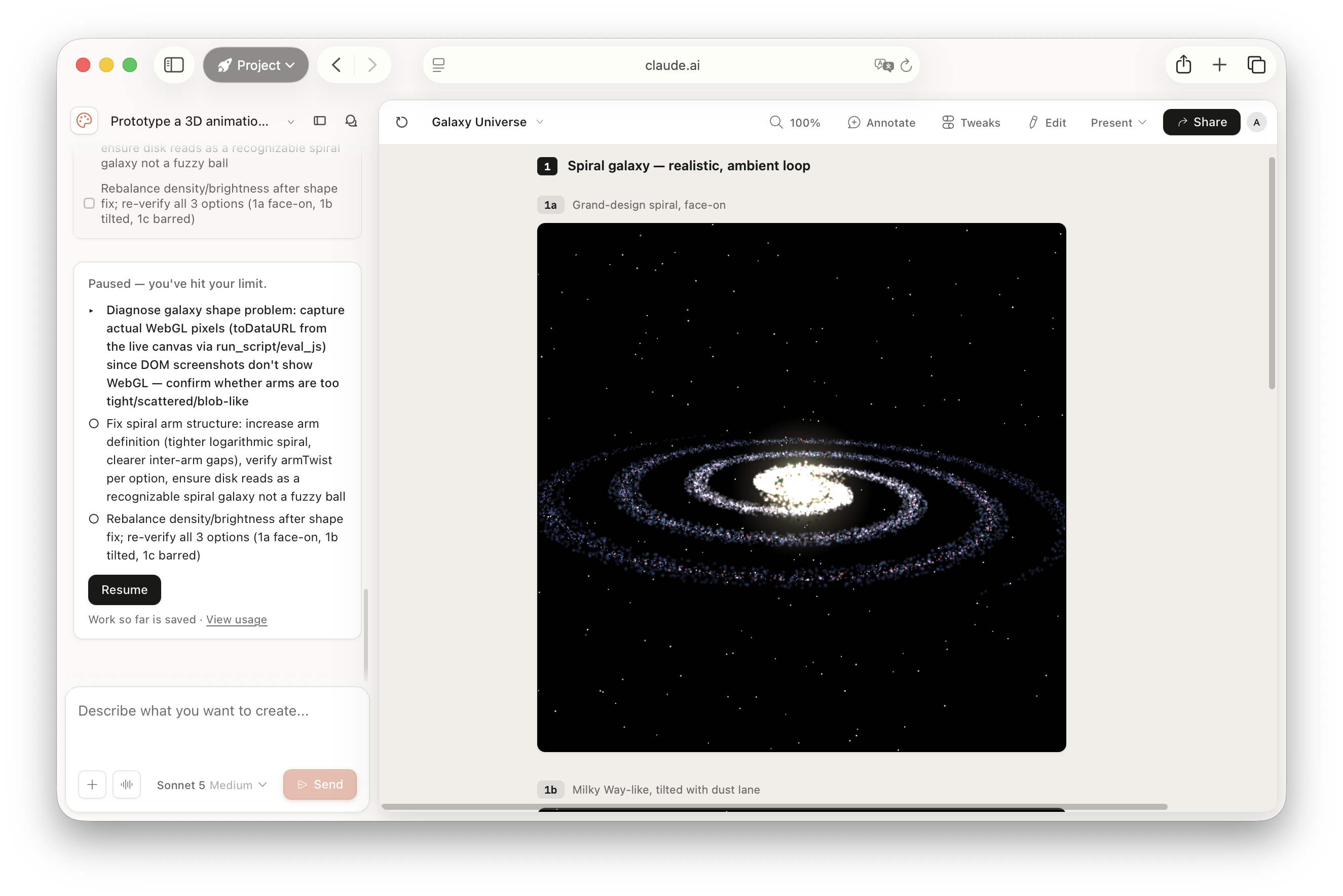
AIが何を言ってるかわからなくなってきてからが本番